

Views: 123 Author: Site Editor Publish Time: 2026-10-27 Origin: Site


Manufacturing silicone kitchenware requires strict control over material inputs on the production floor. Aesthetic appeal drives consumer sales, but improper colorant selection compromises product safety, mechanical integrity, and regulatory compliance. Production engineers face the challenge of achieving vibrant, consistent branding while maintaining the non-toxic, heat-resistant properties required for culinary applications. The wrong chemical choice introduces severe risks. Pigment leaching into food, thermal degradation in consumer ovens, and curing inhibition during the molding process can halt production and trigger costly recalls. This article provides a technical evaluation framework for production engineers and procurement teams. We will outline how to assess, shortlist, and integrate the correct colorant formulations for commercial kitchenware manufacturing. Finding a reliable silicone colorant for kitchenware requires navigating complex chemical compatibility, thermal limits, and strict global regulatory standards to ensure a flawless final product.
Compliance is Binary: Only certified food-grade silicone colorants meeting FDA (US) or LFGB (Europe) standards are viable; industrial or craft-grade pigments introduce severe liability.
Format Dictates Process: The choice between liquid silicone pigment and solid masterbatch depends entirely on your base material (LSR vs. HCR) and injection/molding infrastructure.
Thermal Stability is Non-Negotiable: A silicone pigment for bakeware must withstand continuous exposure to temperatures exceeding 250°C (480°F) without shifting hue or off-gassing.
Pigment Loading Impacts Performance: Over-saturating silicone with colorant to achieve opacity degrades the tear strength and flexibility of the final kitchenware product.
The baseline requirement for any material entering a culinary environment is absolute chemical safety. Colorants used in kitchenware must never contain heavy metals like lead, cadmium, or mercury. They must be free of toxic plasticizers such as phthalates and any unapproved chemical additives. When a consumer uses a silicone spatula in boiling oil or places a baking mat in a hot oven, the material undergoes severe thermal and chemical stress. If the colorant is not strictly formulated for food contact, these extreme conditions trigger the migration of hazardous compounds directly into the food.
Understanding the distinction between global standards is mandatory for international distribution. The US standard, FDA 21 CFR 177.2600, governs rubber articles intended for repeated food contact. It focuses on strict extraction limits, testing how much material leaches out when exposed to distilled water and n-hexane over specific timeframes under reflux conditions. In contrast, the German and European standard, LFGB (specifically referencing BfR XV recommendations for silicones), is significantly more stringent. LFGB mandates rigorous testing for volatile organic compounds (VOCs) and peroxide residues. It also requires comprehensive sensory testing to guarantee that the food-grade silicone colorant does not alter the taste or odor of the food it touches.
You cannot rely on verbal assurances from suppliers regarding these standards. Request and verify Safety Data Sheets (SDS) and Technical Data Sheets (TDS) before initiating any material trials. Demand third-party laboratory test reports confirming that the specific pigment formulation passes both extraction and sensory tests under the exact curing and post-curing conditions you intend to use on your production line. Post-curing, typically done at 200°C for four hours, is often required to drive off volatile byproducts, and the colorant must survive this process without degrading.
Kitchenware operates in some of the most punishing domestic environments imaginable. Products are routinely subjected to the intense, dry heat of baking ovens, the localized radiation of microwaves, and the harsh, caustic detergents used in high-temperature dishwasher cycles. A colorant that looks vibrant at room temperature might fail catastrophically when subjected to these conditions on a daily basis.
Establishing the criteria for a reliable silicone pigment for bakeware requires looking closely at its thermal threshold. The pigment must resist color fading, scorching, or chemical breakdown under repeated thermal cycling. Industry standards dictate that bakeware colorants must remain completely stable under continuous exposure to temperatures exceeding 250°C (480°F). While the siloxane bonds of the base silicone rubber easily handle this heat, organic pigments often burn, turning black and releasing unwanted carbon compounds. High-heat applications typically rely on highly refined inorganic pigments, such as specific iron oxides, ultramarines, or titanium dioxide. These inorganic compounds can endure extreme thermal stress without shifting hue, migrating, or off-gassing.
The chemical interaction between your chosen colorant and the base elastomer dictates the success or failure of the entire production run. When working with food-grade platinum silicone rubber, the curing mechanism relies on a highly sensitive platinum catalyst to facilitate the hydrosilylation reaction. This reaction cross-links the polymer chains, transforming the liquid or gum into a durable, solid elastomer.
This platinum catalyst is notoriously easy to poison. If your colorant formulation contains even trace amounts of incompatible amines, sulfur compounds, phosphorus, or heavy metal salts (like tin, often found in cheaper condensation-cure systems), the catalyst will be neutralized. When catalyst inhibition occurs, the silicone fails to cure properly. You will find a localized sticky surface, a gummy interior, or a complete failure to vulcanize. This ruins the batch and requires extensive downtime to clean the contaminated molds, static mixers, and injection machinery. Vetting the chemical purity of the pigment carrier fluid is just as important as vetting the pigment powder itself.
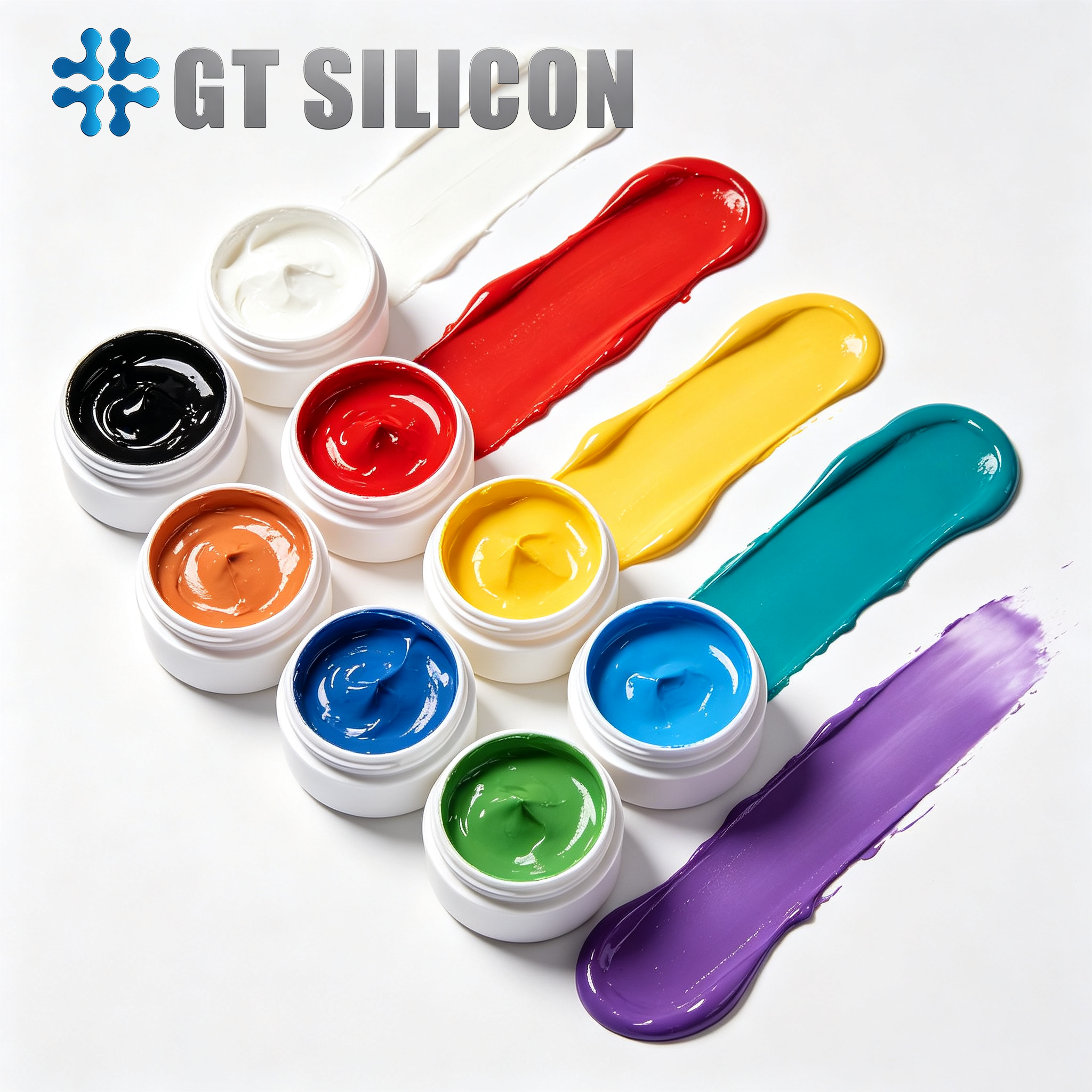
Liquid colorants consist of concentrated pigment particles evenly dispersed within a reactive silicone fluid carrier. This format is engineered specifically for modern injection molding environments. Utilizing a liquid silicone pigment offers seamless integration with Liquid Silicone Rubber (LSR) systems. The liquid format is ideal for automated, closed-loop dosing equipment. The color is pumped from a reservoir and injected directly into the static mixer alongside the A and B components of the LSR just before it enters the mold cavity.
The advantages of this system are substantial for high-volume manufacturing. You achieve exceptionally high dispersion efficiency, meaning the color is perfectly uniform throughout the product without any manual mixing. Because the system is entirely enclosed, there is zero dust contamination on the factory floor, which is critical for maintaining a cleanroom environment suitable for food-grade manufacturing. However, liquid systems require expensive, highly precise metering pumps to ensure the exact color ratio (typically 1% to 3% by weight) is maintained shot after shot. Because the pigment particles are heavier than the silicone carrier fluid, they are prone to separation and settling over time. Liquid colorants must be properly agitated or continuously stirred in their reservoirs to prevent color variations during a long production run.
Solid masterbatches take a completely different approach. These are highly concentrated pigments compounded directly into a solid silicone gum base. The specific composition of a high-quality masterbatch is a precise, heavily engineered blend. It consists of raw silicone material, a specific grade of silicone oil to aid in dispersion, the concentrated color toner, and specialized dispersants. These components are milled together under high shear to ensure the pigment is evenly distributed without any microscopic clumping.
Masterbatches are the undisputed industry standard for High Consistency Rubber (HCR) compression molding. The primary advantage is handling. An operator can easily weigh a solid block of masterbatch and mill it directly into the raw silicone gum on the production floor using a two-roll mill. Masterbatches boast a remarkably long shelf life and do not suffer from the settling issues that plague liquid pigments. The major disadvantage is the labor and equipment required. You need a heavy-duty two-roll mill to generate the sheer force necessary for proper dispersion into the base HCR. Color changeovers are highly labor-intensive, as the massive steel rollers and collection pans must be meticulously cleaned with solvents between different color runs to prevent contamination.
Feature | Liquid Silicone Pigment (LSR) | Silicone Color Masterbatch (HCR) |
|---|---|---|
Base Format | Pigment suspended in reactive silicone fluid | Pigment compounded into solid silicone gum |
Primary Application | Injection Molding (Automated dosing) | Compression Molding (Two-roll milling) |
Dispersion Method | Static mixer before injection nozzle | High-shear mechanical mixing on steel rollers |
Key Advantages | Zero dust, highly automated, perfect consistency | Long shelf life, no settling, easy to weigh |
Main Drawbacks | Prone to settling, requires expensive dosing pumps | Labor-intensive color changeovers, requires heavy milling equipment |
A common misconception among novice manufacturers is the idea of using raw powder pigments or standard industrial dyes directly in the silicone manufacturing process. You must understand the technical distinction between dyes and pigments. Dyes are soluble substances that dissolve entirely into the base material. Because they do not form strong physical bonds within the silicone matrix, dyes are highly prone to thermal bleeding and chemical migration. If a dye is used in a baking mat, the color will eventually leach out into the food or onto the baking sheet. Pigments are insoluble solid particles that remain suspended in the matrix. For food-contact safety, using suspended, non-migratory pigments is strictly mandatory.
Attempting to mix raw powder pigments directly into silicone on a commercial scale is a recipe for failure. Pre-dispersed formats—whether liquid or masterbatch—are mandatory. Raw powders inevitably cause agglomeration, creating microscopic clumps of dry pigment that appear as inconsistent color streaks or weak points in the final product. Raw powders also create severe airborne contamination on the factory floor, coating equipment, entering ventilation systems, and compromising the purity of adjacent clear or white silicone batches.
Consumer brands demand exact aesthetic replication across their entire product line. Translating a specific Pantone or RAL brand color into a stable silicone formulation is a complex scientific process. Custom silicone color matching begins with spectrophotometer analysis. Engineers analyze the target color using the CIELAB color space and formulate a precise ratio of base pigments. They must account for the natural translucency of the raw silicone and the specific temperature at which the product will be cured. Heat often causes slight color shifts during vulcanization, known as thermochromism, which must be calculated into the initial formula.
Batch consistency is maintained through strict adherence to Delta E (ΔE) tolerances. Delta E is a metric that quantifies the visual difference between two colors. In commercial kitchenware manufacturing, a ΔE tolerance of less than 2.0 is generally required to ensure that a spatula produced in January looks identical to one produced in November. Achieving this requires rigorous quality control, standardizing the base elastomer, and ensuring the colorant supplier uses highly controlled, repeatable dispersion methods.
Raw silicone rubber is naturally translucent. This optical property means that simply adding a colored pigment will result in a see-through, often cheap-looking final product. To achieve the rich, solid opacity expected in premium kitchenware, manufacturers must alter the base formulation. The standard technique involves utilizing a food-grade white pigment base, almost exclusively Titanium Dioxide (TiO2), to neutralize the translucency and block light transmission before adding the final target hue.
This process introduces the risk of the blushing or white-stress effect. This phenomenon occurs when a colored silicone product is stretched or bent, and the tensioned area suddenly turns white. Consumers often misinterpret this as a sign of cheap fillers or toxic plastics being mixed into the silicone. In reality, white stress is usually caused by improper pigment dispersion, excessive use of low-quality silica fillers in the base gum, or a mismatch in the refractive index between the pigment particles and the polymer matrix. When stretched, micro-voids form around poorly bonded pigment particles, scattering light and appearing white. Utilizing high-quality, finely milled colorants and selecting a premium base material are the only ways to mitigate this consumer red flag.
Colorants are not passive ingredients; they actively interfere with the polymer matrix. Analyzing the trade-offs of high pigment loading is a critical engineering task. When you add too much colorant to achieve a specific opacity or depth of color, the physical pigment particles get in the way of the polymer chains. This physical interference reduces the overall cross-linking density of the silicone during vulcanization.
The resulting negative outcomes severely impact product lifespan. Reduced cross-linking density directly translates to lower tear strength, reduced tensile strength, and an altered Shore A hardness. High pigment loading in softer silicones, such as those with a 30A to 40A durometer rating used for flexible baking molds, drastically compromises their elasticity. The mold may tear prematurely when a consumer tries to pop out a baked good. Firmer grades, like 60A+ used for rigid spatula handles, can tolerate slightly higher pigment loads, but excessive colorant will still cause them to become brittle over time under high heat.
Defect | Root Cause | Manufacturing Solution |
|---|---|---|
Cure Inhibition (Sticky Surface) | Platinum catalyst poisoned by amines, sulfur, or tin in the colorant. | Switch to high-purity, addition-cure compatible pigments. Audit carrier fluids. |
White Stress (Blushing) | Poor pigment dispersion or excessive cheap silica fillers. | Use pre-dispersed masterbatches. Upgrade base HCR/LSR quality. |
Color Bleeding / Migration | Using soluble dyes instead of insoluble pigments. Over-saturation. | Strictly use inorganic pigments. Keep pigment loading below 3% by weight. |
Reduced Tear Strength | Excessive pigment loading interfering with polymer cross-linking. | Optimize opacity with minimal TiO2. Use higher-strength base elastomers. |
Pigment migration is a catastrophic failure in food-contact applications. The root causes of this issue usually stem from cost-cutting measures. Using non-reactive dyes instead of bound pigments, or exceeding the maximum saturation point of the silicone matrix by adding too much colorant, guarantees that the color will eventually bleed. When the polymer network is full, the excess color has nowhere to go but out to the surface.
The mitigation strategy requires strict procurement discipline. You must utilize colorants specifically engineered to cross-link with the silicone polymer network during vulcanization, or use highly stable inorganic pigments that are physically locked within the dense siloxane matrix. Conduct rigorous extraction testing during the prototyping phase. Subject the colored silicone to boiling water and hexane reflux tests to reveal any migration tendencies before mass production begins.
The operational risks of cross-contamination during color changeovers are a constant threat to manufacturing efficiency. Whether you are purging an injection molding barrel or cleaning a two-roll mill, trace amounts of a previous colorant can easily ruin a subsequent batch, leading to massive material waste.
Preventing this requires strict standard operating procedures (SOPs). Injection equipment must be purged with clear, un-catalyzed silicone until the material runs completely transparent. On a two-roll mill, the steel rollers, the nip, and the collection pans must be scrubbed with approved solvents. Colorant storage must be physically isolated. Liquid pigment pumps and masterbatch boxes should be segregated by color family to prevent an operator from accidentally introducing a dark pigment into a light-colored production run.
Your final product is only as safe and reliable as your supply chain. When vetting a silicone rubber manufacturer and their associated pigment suppliers, conduct a thorough audit. Do not accept marketing claims at face value.
Use a strict checklist for auditing. Verify their ISO 9001 certification to ensure they have standardized quality management systems in place. Confirm they possess in-house spectrophotometer testing capabilities to guarantee batch-to-batch color consistency. Demand full traceability of raw materials; they should be able to trace every batch of pigment back to its chemical origin and provide a Certificate of Analysis (COA) with every delivery. Assess their willingness to provide custom formulation support. A reliable supplier will work with your engineering team to adjust the pigment carrier fluid to match the exact curing kinetics of your specific production line.
Selecting colorants for kitchenware is strictly dictated by your manufacturing process and the uncompromising regulatory demands of food-contact applications. You cannot cut corners on chemical safety when extreme heat and culinary use are involved. Verify absolute FDA or LFGB compliance, match the colorant format to your base silicone infrastructure, validate thermal stability for the specific kitchenware application, and rigorously test for any mechanical degradation caused by pigment loading.
To move forward effectively, follow these actionable steps:
Request physical samples of both the base elastomer and the pre-dispersed colorant from your shortlisted suppliers to verify compatibility.
Conduct in-house trial runs, specifically performing aggressive stretch tests to check for white stress and bake tests at 250°C to monitor thermal degradation.
Demand comprehensive, third-party compliance documentation, including SDS, TDS, and extraction test results, before committing to any bulk order.
Establish strict Delta E tolerances with your supplier to guarantee long-term brand consistency across future production cycles.
Implement strict purging and cleaning SOPs on your factory floor to prevent cross-contamination during color changeovers.
A: It must be formulated without toxic heavy metals, phthalates, or harmful VOCs, and must pass stringent migration testing under FDA (21 CFR 177.2600) or LFGB standards to ensure nothing leaches into food.
A: No. Non-silicone pigments will not chemically bond with the silicone matrix, leading to leaching, curing inhibition (especially in platinum-cured systems), and immediate failure of food safety compliance.
A: High pigment loading can interfere with the polymer cross-linking process, resulting in bakeware that is more prone to tearing, has lower elasticity, and degrades faster under high heat. This is especially critical in softer Shore A hardness formulations.
A: Liquid pigments are suspended in a silicone fluid and are injected directly into Liquid Silicone Rubber (LSR) systems. Masterbatches are solid blocks of highly concentrated pigment, silicone oil, and dispersants mixed into raw silicone gum, used primarily for High Consistency Rubber (HCR) compression molding.
A: Suppliers use spectrophotometers to analyze target colors (like Pantone) and formulate a precise ratio of base pigments. This custom formulation is then tested in the specific silicone base to account for the material's natural translucency and curing temperature.
A: This is often caused by using cheap fillers (like excessive silica or calcium carbonate) in the base silicone, or improper pigment dispersion. High-quality food-grade silicone with properly matched colorants will maintain its hue even under tension.
A: To achieve full opacity, manufacturers typically incorporate a food-grade white pigment (like Titanium Dioxide) into the base formulation to block light transmission before adding the final target colorant.


