

Views: 152 Author: Site Editor Publish Time: 2026-10-16 Origin: Site


Choosing the right skin-safe silicone putty for lifecasting starts with one simple rule: the material must be suitable for direct skin contact during the intended application.
A silicone putty may work perfectly for making jewelry molds or industrial prototypes but still be unsuitable for taking an impression of someone's hand, foot, or face.
At GATO SILICONE, we work with different silicone formulations for mold making, creative projects, and customized applications. We know that lifecasting requires a careful balance of material safety, softness, working time, and detail reproduction.
Whether you're producing handprint keepsakes, working in a professional lifecasting studio, or sourcing silicone putty for your own brand, we'll explain what to look for and how to compare the available materials.
Lifecasting involves taking an impression directly from a person's body to reproduce its shape and surface details.
The mold may capture fingerprints, wrinkles, skin texture, or the shape of a hand or foot.
Unlike conventional mold making, the material comes into contact with living skin while it is still curing.
This makes material selection especially important.
A suitable lifecasting silicone putty should offer:
Documented suitability for the intended skin-contact conditions
Comfortable application without excessive pressure
Enough working time to capture the desired impression
Suitable softness and flexibility after curing
Reliable detail reproduction
Easy removal without unnecessary pulling or discomfort
The physical properties alone are not enough.
Before using any uncured silicone directly on skin, we recommend checking its intended use, technical information, handling instructions, and relevant biological safety documentation.
A label such as "non-toxic" does not automatically establish that a material has been evaluated for direct skin contact.
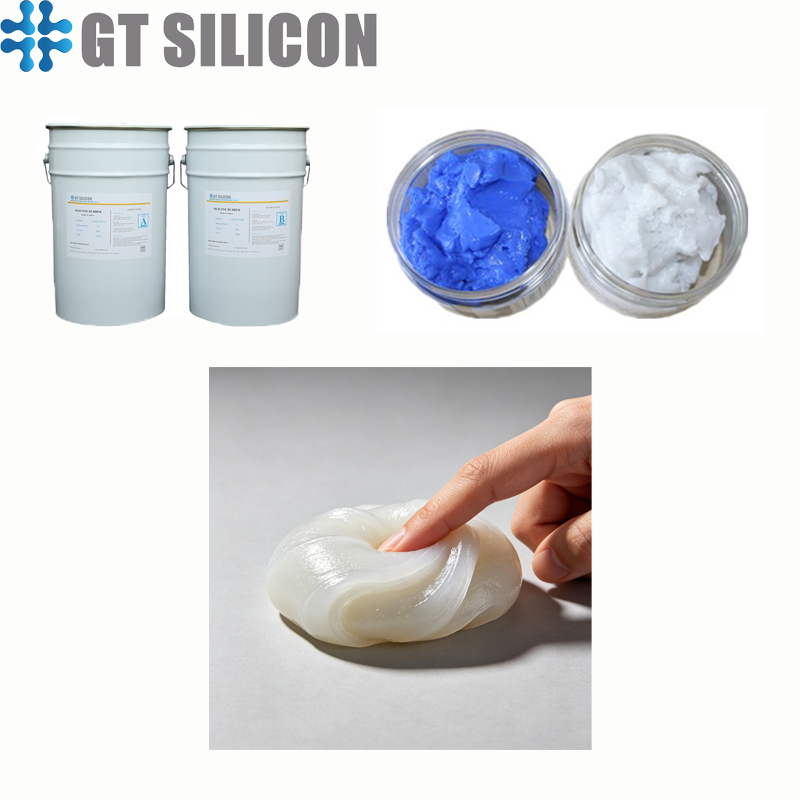
Many lifecasting materials use platinum-cure silicone, also called addition-cure silicone.
This curing system allows two silicone components to react and form an elastic rubber.
Unlike condensation-cure systems, the main addition-curing reaction does not generate small-molecule condensation by-products.
Platinum silicone formulations can also provide low cure shrinkage and good dimensional stability.
These properties are useful when making detailed molds that may need to be stored or reused.
However, we want to clarify an important point: not every platinum-cure silicone is automatically skin-safe.
The complete formulation matters, including its additives, pigments, fillers, and intended contact conditions.
For direct skin applications, buyers should look for product-specific evidence of suitability rather than relying only on the curing chemistry.
Tin-cure silicone uses a different curing mechanism and remains useful for many industrial and artistic mold-making applications.
However, we would not recommend choosing a general-purpose tin-cure product for direct lifecasting without specific evidence that it is suitable for that use.
Our advice is to start with a formulation developed and evaluated for skin contact.
This is more reliable than choosing between platinum and tin solely by material name.
One of the most useful specifications to understand is Shore hardness.
Shore hardness describes how firm or soft the cured silicone feels.
Different hardness levels suit different molding tasks.
A very soft silicone can bend easily around delicate shapes. A firmer silicone may hold its form better but can be more difficult to remove from complex undercuts.
For lifecasting, the right balance matters more than choosing the lowest possible hardness.
Cured hardness | General characteristics | Selection consideration |
|---|---|---|
Very soft, around Shore 00 grades | Highly flexible and easily deformed | Useful where softness is essential |
Soft Shore A grades | Flexible with some shape retention | May suit selected impressions |
Medium Shore A grades | Firmer and more supportive | Often useful for general mold making |
Higher Shore A grades | Greater stiffness | Less suitable for delicate undercuts |
These are general material characteristics, not fixed safety recommendations for particular body parts.
Imagine creating a mold of a hand with slightly bent fingers.
There are small spaces between the fingers and natural changes in shape around the joints.
A flexible cured silicone can deform during removal, helping the mold pass around these areas.
A firmer material may require a different mold design, parting lines, or additional support.
However, extreme softness is not always better.
A mold that is too soft may distort when filled with casting material.
At GATO SILICONE, our silicone putty range includes different formulations for hand molding, soft applications, and more demanding mold-making work.
We recommend selecting hardness according to the impression geometry, expected mold use, and verified skin-contact suitability.
Working time is another important factor when choosing RTV silicone putty for lifecasting.
It refers to the period after mixing when the material can still be shaped and applied.
Cure time describes how long the material needs to reach the specified stage of curing.
These two values are not interchangeable.
For example, a putty may allow several minutes for mixing and application but require a longer period before the mold can be removed.
Quick-setting formulations are useful for small impressions that can be completed rapidly.
Handprints and footprints are common examples.
Our Skin-Safe Quick-Set Silicone Putty is developed for hand and footprint keepsake applications.
Its published description indicates rapid setting, with full cure occurring in approximately ten minutes.
For infant applications, adult supervision, verified material suitability, and immediate, easy removal are essential. The material must never obstruct breathing or be used on irritated or damaged skin.
A longer working time can be helpful when the impression requires more careful positioning.
Our Hand-Moldable RTV Silicone Putty has a published working time of approximately three to five minutes and a cure time of around fifteen to twenty minutes.
The product is designed for hand-molded impressions and creative mold-making projects.
However, buyers should confirm the skin-contact suitability of the exact formulation before applying it directly to a person.
Temperature, mixing accuracy, and formulation can influence curing behavior.
A warmer working environment may shorten the available application time.
A cooler environment may slow curing.
We recommend following the selected product's technical instructions rather than relying on a general curing schedule.
Different lifecasting projects place different demands on the material.
We don't recommend choosing a formulation based on one feature, such as softness or fast curing, without considering the complete application.
Here are three relevant options from our product range.
Product | Main application | Key consideration |
|---|---|---|
Hand-Moldable RTV Silicone Putty | Hand-shaped impressions and DIY molds | Practical mixing and shaping |
Skin-Safe Quick-Set Silicone Putty | Baby hand and footprint keepsakes | Short application and curing time |
Ultra-Soft Platinum Silicone Putty | Prosthetics, body art, and special effects | Very soft cured material |
For keepsake businesses, the main priorities are a suitable skin-contact formulation, easy handling, and a predictable curing schedule.
The material should capture fine details without requiring excessive pressure.
Quick-set products can help reduce the time needed for a simple impression, provided the operator can complete the application safely within the available working period.
Professional studios may need to reproduce fingerprints, fabric texture, or small body details.
Hand-moldable putty can be convenient because it stays in place more easily than a low-viscosity liquid.
However, professional lifecasting—particularly around the face—requires specialist procedures and should not be attempted by untrained operators.
Our Ultra-Soft Platinum Silicone Putty is designed for prosthetics, special effects, and body art applications.
Its published description lists a working time of five to seven minutes and curing in approximately fifteen minutes.
The material is intended to provide an extremely soft finished texture.
For these projects, flexibility and appearance may be especially important, but skin-contact documentation and the intended method of use still need to be checked.
Alginate and silicone putty are both used in impression-making, but they behave differently.
Alginate is a water-based impression material that can reproduce fine surface details. It is commonly used for certain temporary molds.
Silicone putty is a kneadable material that cures into an elastic rubber.
The choice depends on what you're casting and how you plan to use the mold.
Feature | Alginate | Silicone putty |
|---|---|---|
Material consistency | Mixed into a paste | Kneadable compound |
Detail reproduction | Good with correct handling | Good with correct application |
Storage stability | Moisture-sensitive after setting | Generally better dimensional stability |
Reusability | Often limited | Can allow repeated casting |
Application | Applied as a paste | Pressed and shaped by hand |
Main consideration | Time-sensitive mold handling | Skin suitability and cure compatibility |
One advantage of silicone putty is that a properly cured mold can often be stored and reused.
Alginate impressions are more sensitive to moisture loss, so they generally need to be cast promptly or handled according to the product's storage instructions.
However, alginate may be preferable for some body-impression techniques. Neither material is automatically appropriate for every application.
We recommend matching the material to the body area, operator experience, casting process, and safety requirements.
One of the most frustrating problems with platinum-cure silicone is cure inhibition.
This happens when certain substances interfere with the curing reaction.
Instead of forming a uniform elastic rubber, the affected area may remain sticky or incompletely cured.
Possible sources of interference include sulfur-containing materials, certain latex-related residues, and incompatible chemicals.
Some cosmetics, release agents, or previously applied materials may also cause problems, depending on their ingredients.
Before starting a lifecasting project, we recommend confirming that the silicone is compatible with everything it may contact.
This includes:
Gloves used during mixing
Skin preparation products
Release agents
Modeling clay or support materials
Pigments and additives
Tools and mixing surfaces
Nitrile gloves are commonly used when preparing platinum-cure materials, but the exact glove and handling requirements should follow the product instructions.
When compatibility is uncertain, a small test cure on a representative non-living surface can help identify inhibition before the main session.
A compatibility test does not establish that a product is safe for direct skin contact.
Good preparation helps improve the impression and reduce avoidable problems.
Before using a skin-contact putty, review the manufacturer's instructions and confirm that the intended application is within its approved scope.
The skin should be clean, intact, and free from incompatible products.
Avoid applying the material over wounds, irritated skin, or areas where removal could cause harm.
Body hair can become mechanically trapped in a cured mold.
This is particularly important around eyebrows, beards, and other areas with dense hair.
A compatible barrier or release product may be needed for certain applications, but it should be tested for both skin suitability and cure compatibility.
It should not be assumed that every release cream works with every silicone.
The mold must be designed so it can be removed without excessive pulling or pressure.
Deep undercuts and complex shapes require particular care.
For direct body casting, the subject must be able to communicate discomfort and stop the procedure immediately.
Never cover the nose or mouth, obstruct breathing, or use a rigid casting material directly on the body.
Full-face or head lifecasting requires specialist training and appropriate safety arrangements.
The aim is not simply to capture more detail. It is to produce a usable impression while keeping the subject comfortable and safe.
If you're sourcing skin-safe silicone putty wholesale, product consistency and documentation are just as important as the initial sample.
A lifecasting studio, craft brand, or keepsake-kit distributor needs to know that the supplied material matches its intended application.
We recommend reviewing several items before placing a bulk order.
A Technical Data Sheet (TDS) should describe the material's performance and processing requirements.
Relevant information includes mixing ratio, working time, cure time, hardness, and other applicable mechanical properties.
Always check whether the mixing ratio is measured by weight or by volume.
The two methods are not automatically interchangeable.
A Safety Data Sheet (SDS) provides information about hazards, handling, and storage.
However, an SDS alone does not prove that uncured silicone has been evaluated for lifecasting.
For direct skin-contact products, ask the supplier for relevant irritation and sensitization data, the tested formulation, and the conditions covered by the evaluation.
Before approving a wholesale order, we recommend evaluating a sample under representative conditions.
Check how easily the components mix, how the putty handles, and whether the cured material matches the required properties.
For repeat orders, agreed specifications and batch consistency become especially important.
GT Silicon offers silicone material customization and supply services for buyers with different formulation, packaging, and procurement needs.
For OEM silicone putty brands, customization discussions may include hardness, color, cure profile, packaging, and product identification, subject to technical feasibility and the required safety evaluation.
Any formulation change intended for direct skin contact should be reviewed against the applicable safety documentation.
Choosing skin-safe silicone putty for lifecasting requires more than finding a soft, fast-curing material.
The first priority is verifying that the exact formulation is suitable for the intended skin-contact application. Platinum-cure silicone can offer useful properties, including low shrinkage and dimensional stability, but the curing system alone does not establish skin safety.
After that, consider hardness, working time, cure time, flexibility, and mold removal.
A quick-set formulation may suit small hand or footprint impressions, while a longer working time can help with more detailed mold preparation. Very soft silicone grades may be useful in selected prosthetic or special effects applications.
We also recommend checking the material's compatibility with gloves, release agents, and other substances used during preparation.
For professional studios and wholesale buyers, technical documentation, product samples, and consistent manufacturing are important parts of choosing a reliable supplier.
At GATO SILICONE, we offer silicone putty formulations for different molding and creative applications. Our team works with customers to identify suitable material properties and discuss customization requirements.
By selecting the right formulation and following appropriate safety and handling procedures, you can achieve detailed impressions while reducing unnecessary processing and application risks.
No, direct skin-contact suitability must be verified for the specific formulation and intended application.
The best hardness depends on the body area, mold shape, removal requirements, and the selected product's verified properties.
Yes, GT Silicon offers silicone putty supply and selected OEM customization options, with skin-contact suitability requiring confirmation for the final formulation.


